
A New Standard for Bilingual Education
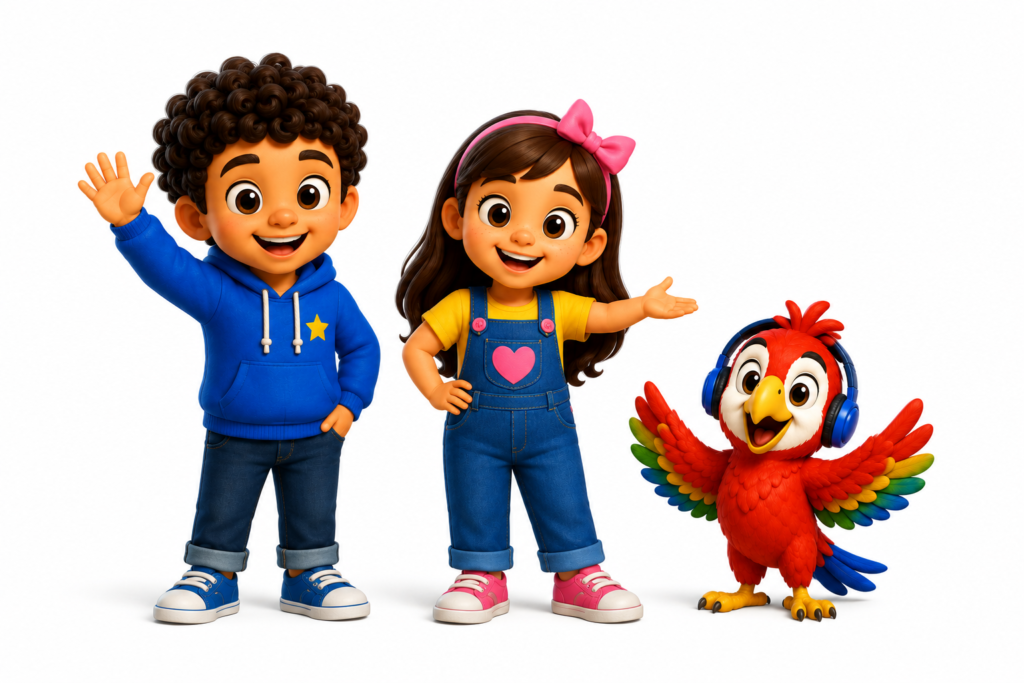
MBBL System™ — Developed by Mega Bilingual Books
Most bilingual learning materials teach two languages.
The Mega Bilingual Balanced Learning System™ does something different.
It treats both languages as equals — not just in theory, but in every activity, every audio element, and every page of every resource designed under this methodology.
That is not a common standard in bilingual education.
It is a new one.
The Problem This System Was Built to Solve
Walk into any classroom, open many bilingual workbooks, or download many language learning apps — and you will often find the same pattern.
One language leads.
The other follows.
English at the top of the page, larger and bolder. Spanish underneath, smaller, lighter, present but secondary.
English activities on one side. Spanish translations on the other.
One language with audio support. One language without.
Children absorb this hierarchy without anyone explaining it.
They learn which language the material seems to consider more important.
And over time, that hierarchy can shape how they relate to both languages.
The Mega Bilingual Balanced Learning System™ rejects that hierarchy entirely.
The Five Principles of the MBBL System™
The MBBL System™ is built on five principles that make English and Spanish equal partners in the learning process.
Principle 1 — Equal Language Weight
In every MBBL System™ resource, English and Spanish receive equal visual weight on the page.
Same font size.
Same prominence.
Same space.
Neither language appears to be the translation of the other.
A child who opens an MBBL System™ workbook should not be able to determine which language is “the main one.”
Because there is no main one.
Both languages are home.
Principle 2 — Bidirectional Practice
Traditional bilingual materials often ask one question:
“What is the Spanish word for dog?”
MBBL System™ materials ask two:
“What is the Spanish word for dog?”
and
“What is the English word for perro?”
Both directions.
Every time.
Because bilingual confidence requires being able to move in both directions — not just from the dominant language to the secondary one.
Principle 3 — Equal Audio Support
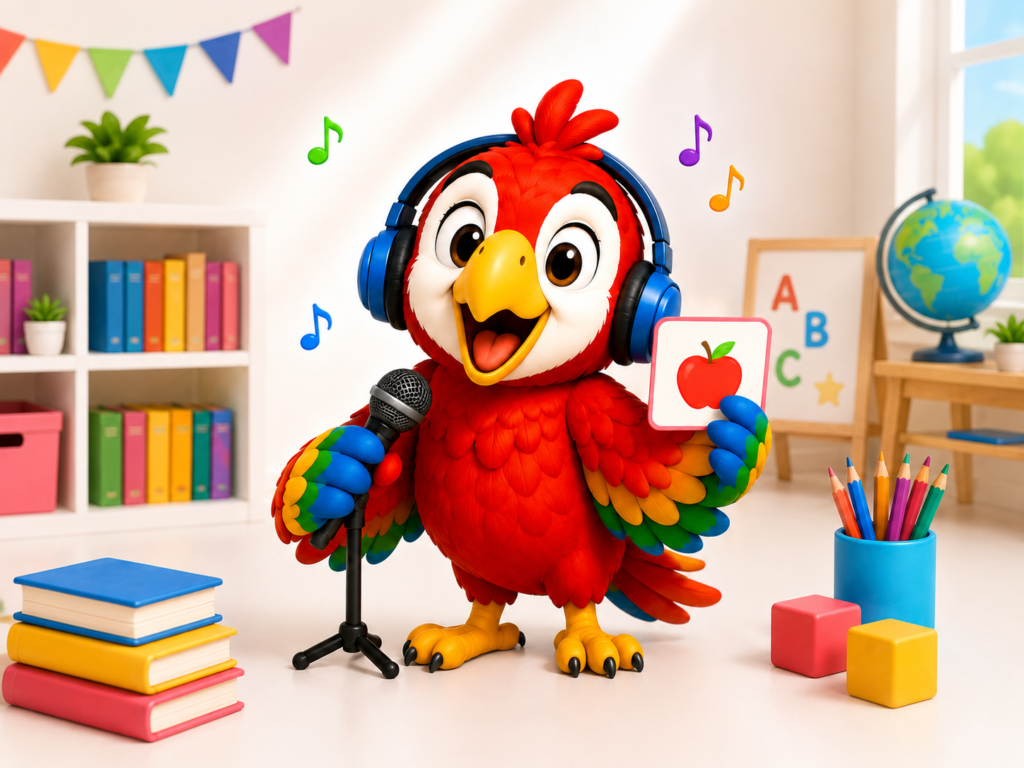
Pronunciation learning requires hearing.
And hearing requires audio support in both languages — not just one.
MBBL System™ resources use QR audio support to provide clear pronunciation practice for vocabulary items in English and Spanish.
Equal audio time.
Equal audio quality.
Equal access.
The audio is designed to support learning without turning the screen into the center of the experience.
Children scan, listen, and return their attention to the page.
Headphones on.
Phone face-down.
Eyes on the book.
Principle 4 — The Three-Page Segment System
Every vocabulary segment in an MBBL System™ workbook follows a consistent three-page structure:
Page 1 — English Practice
Vocabulary introduction, tracing, matching, and mini challenge activities — entirely in English.
Page 2 — Spanish Practice
Identical structure, identical activities, identical depth — entirely in Spanish.
Page 3 — Integration
Both languages together.
Matching pairs, bilingual coloring activities, and writing challenges that require the child to work in English and Spanish simultaneously.
Every segment closes with a Super Challenge — a detailed illustrated scene where children find, name, and say learned words in both languages.
This structure ensures that English and Spanish receive not just equal page space, but equal cognitive practice at every stage of learning.
Principle 5 — Curriculum-Informed Design
The MBBL System™ is not a random collection of activities.
It is a structured learning methodology designed to support skills commonly practiced in first and second grade learning environments in the United States.
Children using MBBL System™ resources are not choosing between bilingual practice and academic progress.
They are doing both at the same time — building bilingual vocabulary, listening, pronunciation, early reading, writing, memory, and confidence.
This makes MBBL System™ resources appropriate for home learning, homeschool routines, classroom support, and educational enrichment.
The Role of Leo, Sofía, and Pancho
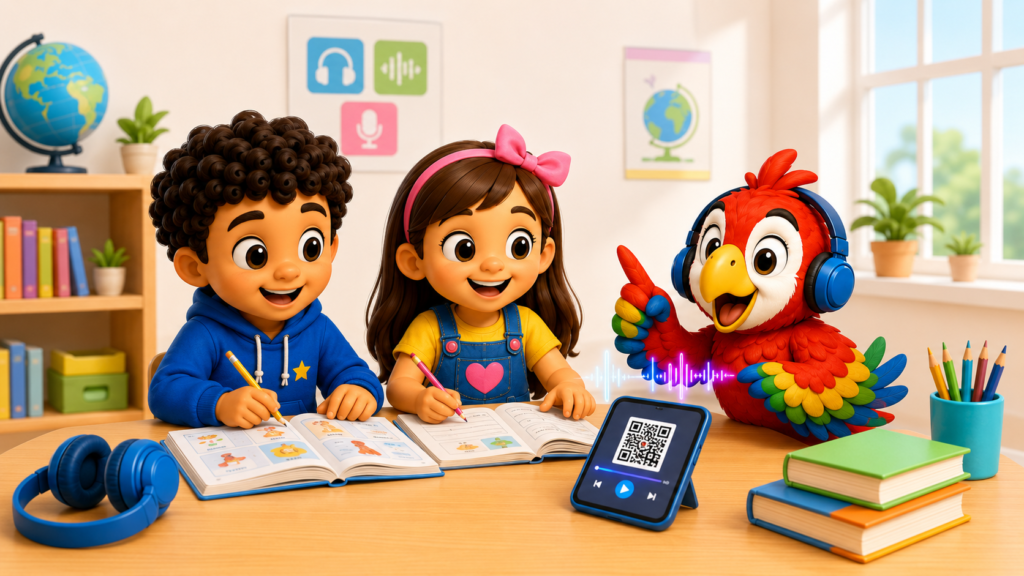
Every MBBL System™ resource is guided by three characters who embody the principles of the system.
Leo models persistence — the understanding that learning a language takes time, repetition, and the willingness to try again.
Sofía models enthusiasm — the understanding that attempting a word before you are certain is not a mistake. It is how language learning works.
Pancho models listening — the understanding that hearing a word clearly, repeatedly, and without distraction is the foundation of pronunciation confidence.
Together, they demonstrate that bilingual learning is not a test to pass.
It is a practice to develop — one word, one page, one session at a time.
Who the MBBL System™ Is Designed For
The MBBL System™ is designed for:
Children ages 6–8
For children building pronunciation patterns, vocabulary foundations, early reading skills, writing habits, and language confidence.
Parents
For parents who want to support bilingual learning at home, regardless of their own fluency in either language.
Homeschool families
For homeschool families who need a structured, flexible, and genuinely balanced bilingual resource that can fit naturally into an existing weekly routine.
Teachers
For teachers who need bilingual activities that are ready to use without extra preparation time.
Schools and educational programs
For institutions interested in balanced bilingual resources that support practice in both languages.
MBBL System™ Resources
All resources developed under the Mega Bilingual Balanced Learning System™ carry the MBBL System™ designation and are built around the five principles of the system.
Current MBBL System™ Resources
Learn English & Spanish Together
A bilingual activity workbook for children ages 6–8 with 120+ pages, QR audio in both languages, and the complete three-page segment system.
Free MBBL System™ Resource
Mega Bilingual Activity Sampler
A free printable introduction to the MBBL System™ — vocabulary activities, QR audio practice, and a Super Challenge scene in English and Spanish.
For Schools and Educators
If you are interested in using the Mega Bilingual Balanced Learning System™ in your school, classroom, homeschool program, or educational setting — or if you would like information about future educator resources, bulk orders, or institutional licensing — we would love to hear from you.
Legal Notice
The Mega Bilingual Balanced Learning System™ is a methodology developed by Mega Bilingual Books.
The content, text, illustrations, audio resources, activities, and educational materials developed by Mega Bilingual Books are protected by copyright.
The Mega Bilingual Balanced Learning System™ name and MBBL System™ designation are intended for trademark registration.
Mega Bilingual Books
Both Languages. Always Together. Always Equal.